
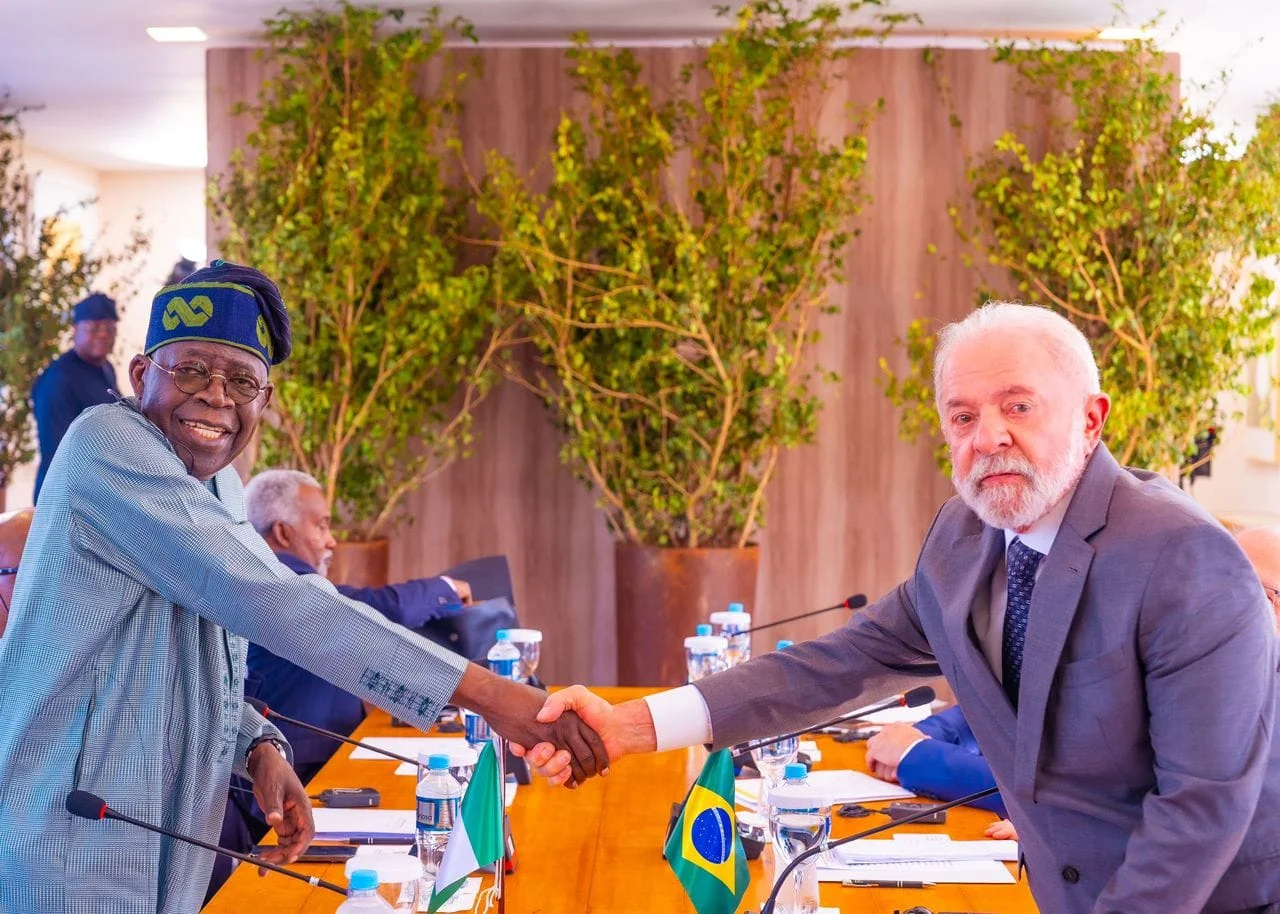
At the request of President Luiz Inácio Lula da Silva, President Bola Ahmed Tinubu is currently in Brazil on a two-day state visit aimed at enhancing bilateral trade relations and bolstering economic cooperation, specifically in the areas of aviation, agriculture, and livestock development.
One of the major agreements, according to the Nigerian government, would bring back direct flights between Rio de Janeiro and Lagos. This will be made possible by Brazil’s national airline, Varig Air, as well as Nigerian airlines, Air Peace and Caverton.
During the meeting, Nigeria’s Minister of Aviation, Festus Keyamo, will sign the deal.
Both presidents are eager to discuss the agriculture sector, which is viewed as a crucial area for expansion, in addition to aviation.
One significant result of this partnership is the Green Imperative Partnership (GIP), which aims to increase mechanization in Nigerian agriculture.
“The GIP is a US$1.1 billion initiative that will supply 10,000 tractors and 50,000 pieces of equipment, all to be assembled locally in Nigeria,” said Tinubu.
He added that the initiative is anticipated to change Nigeria’s agricultural landscape by creating millions of indirect jobs in addition to over 100,000 direct jobs.
In his explanation of the significance of the Green Imperative Partnership, Sunday Dare, President Tinubu’s special adviser, said that “this programme will not only advance agricultural mechanisation but also significantly improve food security in Nigeria.”
He emphasized that this agreement is a component of a plan to tackle common issues including climate change, food security, and technology advancement.
According to Dare, the partnership is a “clear demonstration of the growing cooperation between the two nations, both leaders of the Global South.”
Brazil’s help extends beyond mechanization, the Nigerian president added.
“We are looking to leverage Brazil’s expertise in livestock farming to improve Nigeria’s livestock sector,” Tinubu said.
He continued by explaining that the Ministry of Livestock Development was established in order to increase Nigeria’s ability to supply its expanding demand for animal products.
“This collaboration with Brazil will bring vital investment into Nigeria’s livestock industry, supporting long-term economic growth,” he noted.
In recent years, there have been changes in trade between Nigeria and Brazil. The Nigerian government claims that commerce decreased from US$9 billion ten years ago to US$1.6 billion in 2023.
Tinubu is nevertheless upbeat about the prospects for further expansion.
He stated, “While the trade figures have contracted, sectors like agriculture and agro-processing are increasingly bridging the gap between our economies.”
In October 2024 alone, Nigeria delivered US$0.62 billion worth of non-oil commodities to Brazil, he added, demonstrating an increase in Nigeria’s non-oil exports to that country.
Both nations have set lofty targets to boost commerce in the future.
“We are determined to push bilateral trade above US$2 billion and aim for US$3.5 billion by 2030,” Tinubu said.
He emphasized that the BASA agreement’s reintroduction of direct flights between the two nations will create new opportunities for investment, trade, and tourism.
“This agreement will dramatically improve connectivity, lower costs, and unlock new flows of trade,” Tinubu added.
Sunday Dare said that both countries would gain in the long run from the collaboration.
“With Brazil’s advanced agricultural mechanisation and Nigeria’s vast arable land, the potential for collaboration is immense,” he said.