
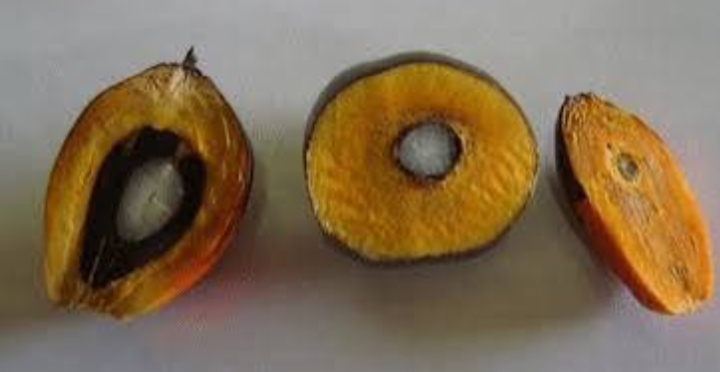
Oil palm is a highly valuable crop in tropical regions, particularly in West Africa, where it contributes significantly to both household consumption and industrial production. The crop exists in three main fruit forms—Tenera, Dura, and Pisifera—which differ in structure, oil content, and overall economic importance. Knowing the differences among these types helps farmers make better production decisions.
Dura
Dura is the original or traditional form of oil palm. Its fruits have a very thick shell and a relatively small amount of pulp (mesocarp), which limits oil production.
- Features: Thick shell (about 2–8 mm), low pulp content
- Oil yield: Low
- Strengths: Strong and adaptable to various conditions
- Limitations: Not very profitable due to low oil output
Despite its resilience, Dura is rarely used in large-scale commercial production because of its lower efficiency.
Pisifera
Pisifera differs from Dura in that it has no shell and a large amount of pulp. However, it is usually female sterile, meaning it does not produce fruits effectively on its own.
- Features: Shell-less fruit, high pulp content
- Oil yield: High potential, but limited in practice
- Strengths: Important for breeding improved varieties
- Limitations: Not suitable for direct cultivation
Because of its sterility, Pisifera is mainly used in hybridization programs rather than farming.
Tenera
Tenera is a hybrid obtained by crossing Dura with Pisifera. It combines the beneficial traits of both parents and is the most commonly cultivated oil palm type.
- Features: Thin shell (about 0.5–4 mm), thick pulp
- Oil yield: High
- Strengths: High productivity, better oil extraction, widely grown
- Limitations: Requires proper breeding to maintain quality
Tenera is favored in commercial plantations because it produces more oil per fruit than other types.
Key Differences
- Shell thickness: Dura (thickest), Tenera (thin), Pisifera (none)
- Pulp content: Pisifera and Tenera (high), Dura (low)
- Oil production: Tenera (highest), Pisifera (theoretical), Dura (lowest)
- Economic value: Tenera is the most profitable and widely planted
Conclusion
Out of the three oil palm forms, Tenera is the most important for modern agriculture due to its superior oil yield and efficiency. While Dura remains useful as a hardy type and Pisifera is essential for breeding, Tenera dominates commercial production and offers the best returns for farmers.