
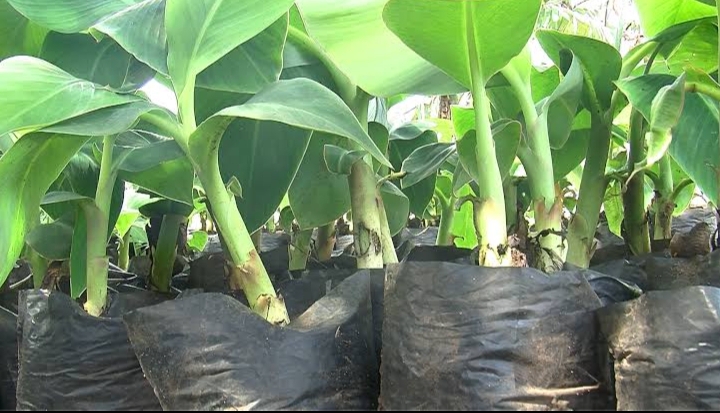
Plantain is propagated vegetatively, meaning farmers use parts of an existing plant rather than seeds. The main objective is to quickly produce strong, healthy planting materials that will give good yields.
1. Sword Sucker Method (Most Common Approach)
This is the most widely used method among farmers.
A sword sucker is a young shoot with narrow, pointed leaves, usually found growing from a healthy mother plant. It is preferred because it develops into a strong and productive plant.
Key benefits:
- High survival rate after planting
- Produces uniform, vigorous plants
- Easy to identify and collect in the field
Farmers typically avoid water suckers since they are weaker and less productive.
2. Corm Splitting Technique
Here, the underground stem (corm) is divided into sections, each containing at least one active bud.
Process:
- Uproot a healthy plant
- Clean and cut the corm into pieces
- Treat sections to prevent disease infection
- Plant them in a nursery or prepared field
Advantages:
- One plant can produce multiple seedlings
- Helpful when suckers are not readily available
3. Use of Young Suckers (Peepers)
Peepers are newly emerging suckers at the early growth stage.
Advantages:
- Can be multiplied quickly in nursery setups
- Useful for large-scale seedling production
Drawbacks:
- Requires careful handling and good nursery conditions
- More prone to disease if not properly managed
4. Macropropagation Technique
This is a controlled nursery method used to produce many suckers from one plant.
How it is done:
- The corm is cleaned and prepared
- Growth buds are encouraged under controlled moisture conditions
- New shoots are developed and later separated for planting
Benefits:
- Produces many uniform and healthy planting materials
- Reduces disease transmission
- Faster multiplication compared to field-based methods
5. Tissue Culture Method
This is a laboratory-based propagation technique where plantlets are grown from plant tissues in sterile conditions.
Advantages:
- Produces disease-free plantlets
- Very high multiplication rate
- Ensures uniform growth and yield
Limitations:
- Expensive to set up
- Requires technical knowledge and facilities
- Less accessible to small-scale farmers
Good Farming Practices
- Always select planting materials from healthy, high-yielding plants
- Avoid waterlogged soils for planting
- Treat suckers before planting to prevent disease
- Maintain proper spacing for healthy growth and better yield
Conclusion
The success of a plantain farm depends heavily on the quality of planting materials. Whether using simple sword suckers or advanced tissue culture methods, strong and healthy propagation materials are the foundation for high productivity and better market performance.