
Cassava is a major agricultural crop grown in many tropical regions around the world. It is widely valued for its affordability, adaptability, and multiple uses in both food and industrial production. Apart from being consumed directly, cassava can also be processed into flour and starch, which are important products in many industries.
Converting cassava into flour and starch helps reduce spoilage, extend shelf life, create employment opportunities, and increase the commercial value of the crop. These products are used in food processing, manufacturing, pharmaceuticals, textiles, and several other industries.
Understanding Cassava Flour and Starch
Although both products come from cassava roots, they are different in composition and processing methods.
Cassava Flour
Cassava flour is produced by drying and grinding the whole cassava root.
It contains:
- natural starch
- fiber
- nutrients from the root
Cassava flour is commonly used in:
- baking
- cooking
- soup thickening
- gluten-free food products
Cassava Starch
Cassava starch is the purified carbohydrate extracted from cassava roots.
Unlike flour, starch is separated from fiber and other root components during processing.
It is widely used in:
- food production
- pharmaceuticals
- paper manufacturing
- textiles
- adhesives
- industrial products
Steps Involved in Producing Cassava Flour
Harvesting
The first step involves harvesting mature cassava roots. Freshly harvested roots are preferred because they contain high starch content and produce better-quality flour.
Spoiled or damaged roots are usually removed during sorting.
Peeling
The outer skin and thick peel are removed carefully to improve product quality and cleanliness.
Washing
After peeling, the cassava roots are washed thoroughly to eliminate:
- dirt
- sand
- impurities
Proper washing is important for food safety and hygiene.
Cutting or Grating
The cassava is sliced into smaller pieces or grated into mash.
Smaller pieces allow faster and more uniform drying.
Drying
The cassava pieces are dried to reduce moisture and prevent spoilage.
Drying methods may include:
- sun drying
- solar drying
- mechanical drying
Proper drying improves shelf life and reduces the risk of mold growth.
Milling
The dried cassava is ground into fine flour using milling machines.
The flour may also be sieved to achieve a smoother texture.
Packaging and Storage
Finished flour is packaged in sealed, moisture-resistant bags and stored in dry conditions to maintain quality.
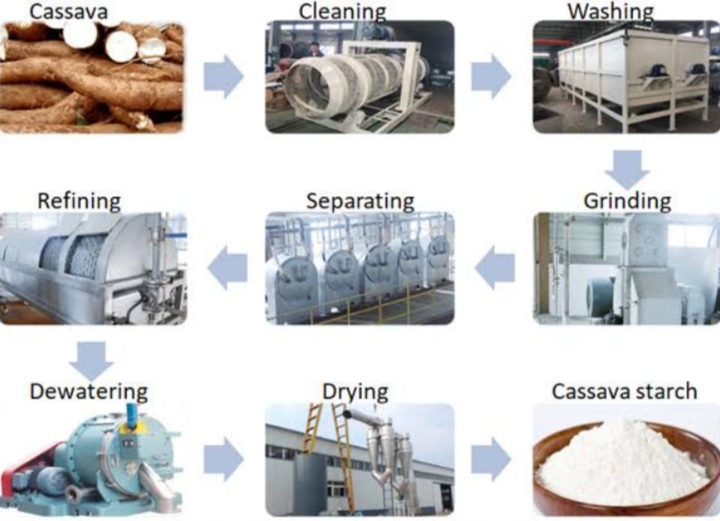
Steps Involved in Producing Cassava Starch
Cassava starch production requires more processing stages than flour production.
Cleaning and Peeling
Fresh cassava roots are washed and peeled thoroughly before processing.
Crushing or Grating
The roots are grated into wet pulp to release starch granules.
Mixing With Water
Water is added to the pulp and mixed thoroughly to separate starch from fibrous materials.
Filtration
The mixture is filtered through cloth or mesh to remove fiber.
The filtered liquid contains suspended starch particles.
Sedimentation
The starch solution is left to stand for several hours, allowing the starch to settle at the bottom.
Draining Excess Water
The water above the settled starch is carefully removed.
Drying the Starch
The wet starch is dried using sunlight or drying equipment until the moisture content is low enough for storage.
Grinding and Packaging
The dried starch is milled into fine powder and packaged for commercial distribution.
Uses of Cassava Flour
Cassava flour is increasingly popular because it is naturally gluten-free and versatile.
It is used in:
- bread making
- pastries
- pancakes
- noodles
- sauces
- traditional dishes
Some countries also mix cassava flour with wheat flour to reduce dependence on imported wheat.
Uses of Cassava Starch
Cassava starch serves both food and industrial purposes.
Food Applications
It is commonly used in:
- noodles
- confectionery
- beverages
- processed foods
- sweeteners
Industrial Applications
Industries use cassava starch in:
- textile production
- paper manufacturing
- adhesives
- biodegradable packaging
- pharmaceutical products
Its purity and smooth texture make it highly valuable in manufacturing.
Advantages of Cassava Processing
Processing cassava into flour and starch offers several benefits:
- reduces post-harvest waste
- extends shelf life
- increases farmers’ income
- creates employment opportunities
- supports food security
- promotes industrial growth
Value addition also improves the economic importance of cassava farming.
Challenges Facing Cassava Processing
Despite its advantages, cassava processing faces several difficulties, including:
- limited access to modern equipment
- high processing costs
- poor transportation systems
- unstable electricity supply
- contamination risks during drying
- inadequate storage facilities
Many small-scale processors still depend heavily on manual labor, which can reduce efficiency.
Future Opportunities in Cassava Processing
Global demand for cassava products continues to increase, especially for gluten-free foods and industrial starch applications.
With improved technology and investment, cassava processing can:
- create more jobs
- improve rural livelihoods
- support local industries
- increase export opportunities
- strengthen food production systems
Several countries are investing in cassava processing to reduce dependence on imported raw materials and support economic development.
Conclusion
Processing cassava into flour and starch is an important value-addition activity with both economic and industrial benefits.
Cassava flour plays a major role in food preparation, while cassava starch is widely used in food manufacturing and industrial production.
With proper processing techniques, investment, and improved infrastructure, cassava can continue to contribute significantly to food security, employment, and industrial growth worldwide.