
Introduction
Plantain (Musa spp.) is an important tropical fruit crop cultivated for its nutritious fruits and its contribution to household food security and farm income. It grows well in warm, humid climates with adequate rainfall, fertile soil, and good drainage. Successful plantain production depends greatly on proper spacing, good land preparation, appropriate planting materials, effective weed and pest control, adequate nutrition, and proper field sanitation.
Spacing in Plantain Plantation
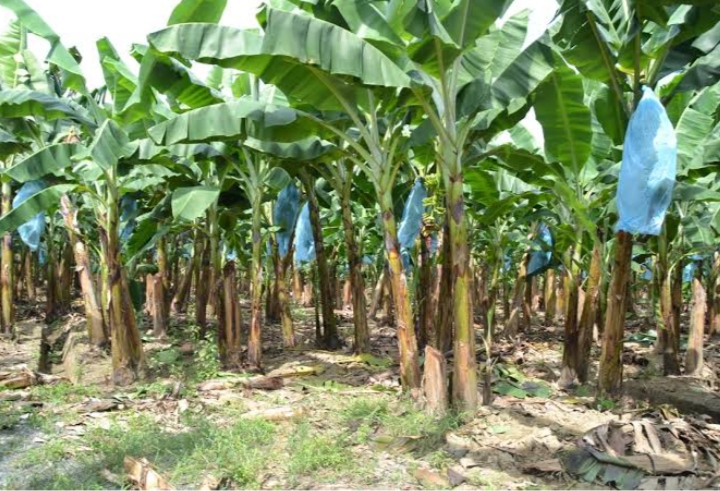
Spacing refers to the distance maintained between plants and between rows. Proper spacing is essential because it determines the number of plants that can be established on a given area and affects light penetration, air circulation, nutrient availability, and ease of farm operations.
Common spacing systems for plantain include 3 m × 3 m, 3 m × 2.5 m, and 2.5 m × 2.5 m. A spacing of about 3 m × 3 m is widely used where vigorous varieties are grown or where soil fertility is high. Closer spacing can increase the number of plants per hectare, but excessive crowding may encourage competition for light, water, and nutrients and can increase humidity within the plantation.
At 3 m × 3 m spacing, approximately 1,111 plants can be accommodated per hectare, assuming a square planting arrangement. The selected spacing should, however, be adjusted according to the plantain variety, soil fertility, rainfall, management practices, and the intended production system.
Land Preparation and Planting
The site should be cleared of excessive vegetation, and perennial weeds should be removed before planting. Plantain performs best on deep, fertile, well-drained soils rich in organic matter. Waterlogged areas should be avoided or provided with adequate drainage.
Planting holes should be prepared sufficiently early, with suitable organic manure or well-decomposed compost incorporated into the soil where available. Healthy planting materials, such as disease-free suckers or properly hardened tissue-culture plantlets, should be selected. Planting is best done when adequate soil moisture is available, particularly at the beginning of the rainy season.
Management Practices
1. Weed Management
Weeds compete with plantain for water, nutrients, light, and space. Weed control is therefore important, especially during the early stages of establishment. Weeding can be carried out manually, mechanically, or through carefully managed herbicide use where appropriate.
Mulching with suitable plant residues can help suppress weeds while conserving soil moisture and adding organic matter as the material decomposes. However, mulch should not be piled directly against the plantain pseudostem because it may encourage pest and disease problems.
2. Nutrient Management
Plantain requires adequate nutrients, particularly nitrogen and potassium, for vigorous growth and good fruit production. Soil testing is useful for determining the nutrient requirements of a plantation.
Organic manure, compost, and recommended mineral fertilizers can be applied according to soil fertility and crop requirements. Fertilizer should be distributed around the plant’s root zone rather than placed directly against the pseudostem. Regular application is generally more effective than applying excessive fertilizer at once.
3. Desuckering
Plantain produces suckers around the mother plant. If too many suckers are allowed to develop, they compete with the main plant for nutrients, water, and sunlight.
Desuckering involves removing unwanted suckers and maintaining a manageable number of plants. In a managed plantation, one healthy follower sucker may be retained to replace the mother plant after harvest. The exact system can vary according to the production objective and local recommendations.
4. Water Management
Plantain requires a consistent supply of moisture, particularly during establishment, flowering, and fruit development. In areas with inadequate rainfall, irrigation can improve growth and yield.
At the same time, excessive water accumulation should be avoided. Good drainage is essential because prolonged waterlogging can damage roots and reduce plant growth.
5. Pest and Disease Management
Plantain plantations may be affected by pests such as banana weevils, nematodes, and various insects, while diseases may include fungal, bacterial, and viral diseases.
Integrated pest management should be practiced. This includes using healthy planting materials, maintaining field sanitation, removing severely affected plants, controlling weeds, monitoring the plantation regularly, and using approved pesticides only when necessary and according to label directions.
Diseased leaves and plant residues should be properly managed rather than left to accumulate around healthy plants. Farm tools should also be kept clean when working with plants suspected of carrying serious diseases.
6. Mulching
Mulching is beneficial in plantain production because it reduces evaporation, suppresses weeds, moderates soil temperature, and contributes organic matter. Suitable materials include dry grass, leaves, and chopped plant residues.
Organic mulch should be applied evenly around the plant while leaving a small space around the pseudostem.
7. Propping
Plantain plants carrying heavy bunches can be blown over by strong winds or bend under the weight of the bunch. Propping can reduce this problem. Wooden poles or other suitable supports can be used to support plants carrying heavy bunches.
8. Removal of Dry and Diseased Leaves
Old, dead, or diseased leaves should be removed regularly. This improves field sanitation and allows better light and air movement within the plantation. Healthy green leaves should not be removed unnecessarily because they contribute to photosynthesis and fruit development.
Harvesting and Post-Harvest Management
Plantains are harvested when the fruits have reached the appropriate maturity for their intended market. Bunches should be cut carefully to prevent bruising and damage to the fruits and the remaining plant.
After harvesting, fruits should be handled gently and transported in a manner that minimizes mechanical injury. Good post-harvest handling helps maintain fruit quality and reduces losses.
Conclusion
Successful plantain production requires careful attention to spacing and continuous plantation management. Appropriate spacing provides sufficient room for plants to obtain light, nutrients, water, and air circulation. Good land preparation, healthy planting materials, weed control, nutrient management, desuckering, water management, pest and disease control, mulching, propping, and proper harvesting all contribute to productive and sustainable plantain plantations. When these practices are properly integrated, farmers can improve plant health, yield, fruit quality, and the economic returns from plantain production.