Introduction
Rice is one of the world’s most important staple foods, feeding billions of people daily. After harvesting, paddy rice must undergo milling to remove the husk and bran layers before it becomes suitable for consumption. The efficiency and quality of this process depend largely on the type of milling facility used. Rice mills generally fall into two broad categories: cottage mills and integrated mills. Each system has distinct characteristics, advantages, and limitations that influence rice quality, profitability, and market competitiveness.
Cottage Rice Mills
Cottage rice mills are small-scale milling units typically owned and operated by individuals, families, or small entrepreneurs. These mills are common in rural areas where rice production is concentrated and where farmers require affordable milling services close to their farms.
Characteristics of Cottage Mills
- Simple machinery and basic technology.
- Limited processing capacity.
- Usually perform only one or two milling operations.
- Depend heavily on manual labor.
- Require relatively low capital investment.
- Serve local communities and nearby markets.
Advantages of Cottage Mills
1. Low Investment Cost
The equipment required for a cottage mill is relatively inexpensive, making it accessible to small entrepreneurs and farmer cooperatives.
2. Rural Employment Generation
These mills create employment opportunities in rural communities through machine operation, grain handling, and transportation.
3. Accessibility for Farmers
Farmers can easily access milling services without transporting paddy over long distances, reducing transportation costs.
4. Flexibility
Small mills can adapt quickly to local market demands and seasonal production variations.
Limitations of Cottage Mills
1. Lower Milling Efficiency
Cottage mills often produce lower recovery rates, resulting in more broken grains and higher losses.
2. Inconsistent Quality
The lack of advanced cleaning, grading, and polishing systems can lead to uneven rice quality.
3. Limited Production Capacity
These mills cannot process large volumes of paddy efficiently, restricting their ability to serve larger markets.
4. Higher Operating Costs per Unit
Due to their small scale, operating costs per ton of rice processed may be relatively high.
Integrated Rice Mills
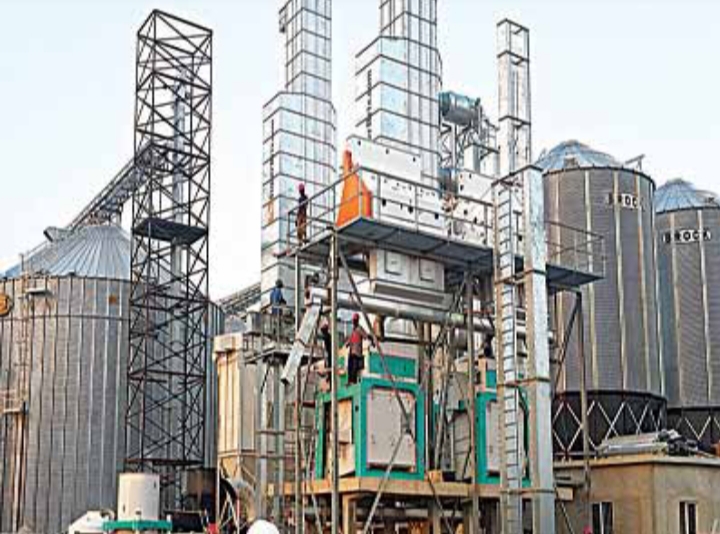
Integrated rice mills are large-scale industrial facilities that perform all rice processing operations within a single plant. They are designed to handle large volumes of paddy while maintaining high efficiency and product quality.
Characteristics of Integrated Mills
- Fully mechanized and automated operations.
- High processing capacity.
- Include cleaning, drying, dehusking, whitening, polishing, grading, sorting, and packaging units.
- Require substantial capital investment.
- Serve regional, national, and export markets.
Advantages of Integrated Mills
1. High Milling Efficiency
Advanced machinery minimizes grain breakage and increases rice recovery rates.
2. Superior Product Quality
Integrated systems ensure uniform grain size, appearance, and cleanliness, making the rice more attractive to consumers.
3. Economies of Scale
Large processing volumes reduce the cost per unit of production.
4. Value Addition
Integrated mills can produce premium rice products, branded rice, and by-products such as rice bran and husk-based energy products.
5. Export Competitiveness
The consistent quality produced by integrated mills meets international standards and market requirements.
Limitations of Integrated Mills
1. High Capital Requirement
Establishing an integrated mill requires significant investment in machinery, infrastructure, and utilities.
2. Technical Expertise Needed
Operation and maintenance require skilled personnel and specialized knowledge.
3. Higher Energy Consumption
Large-scale machinery and drying systems consume substantial amounts of electricity and fuel.
4. Dependence on Continuous Supply
To remain profitable, integrated mills require a steady supply of paddy throughout the year.
Comparative Analysis
| Feature | Cottage Mills | Integrated Mills |
|---|---|---|
| Scale of Operation | Small | Large |
| Capital Investment | Low | High |
| Technology Level | Basic | Advanced |
| Labor Requirement | High | Moderate |
| Milling Efficiency | Lower | Higher |
| Rice Quality | Variable | Consistent |
| Processing Capacity | Limited | Large |
| Market Focus | Local | National and Export |
| Maintenance Complexity | Simple | Complex |
| Profit Potential | Moderate | High |
Economic and Development Implications
Both milling systems play important roles in the rice value chain. Cottage mills contribute to rural development, support smallholder farmers, and improve local food security. Integrated mills enhance industrialization, improve rice quality, reduce post-harvest losses, and strengthen competitiveness in domestic and international markets.
In many developing countries, policymakers encourage the modernization of cottage mills while simultaneously promoting investment in integrated milling facilities. This balanced approach helps achieve both rural livelihood objectives and industrial growth.
Conclusion
Cottage mills and integrated mills serve different but complementary functions within the rice industry. Cottage mills provide accessible and affordable services for rural communities, while integrated mills deliver high-quality rice at large scale with greater efficiency. The choice between the two depends on factors such as available capital, production volume, market requirements, and development goals. For a sustainable and competitive rice sector, both systems must be supported and integrated into the broader agricultural value chain.